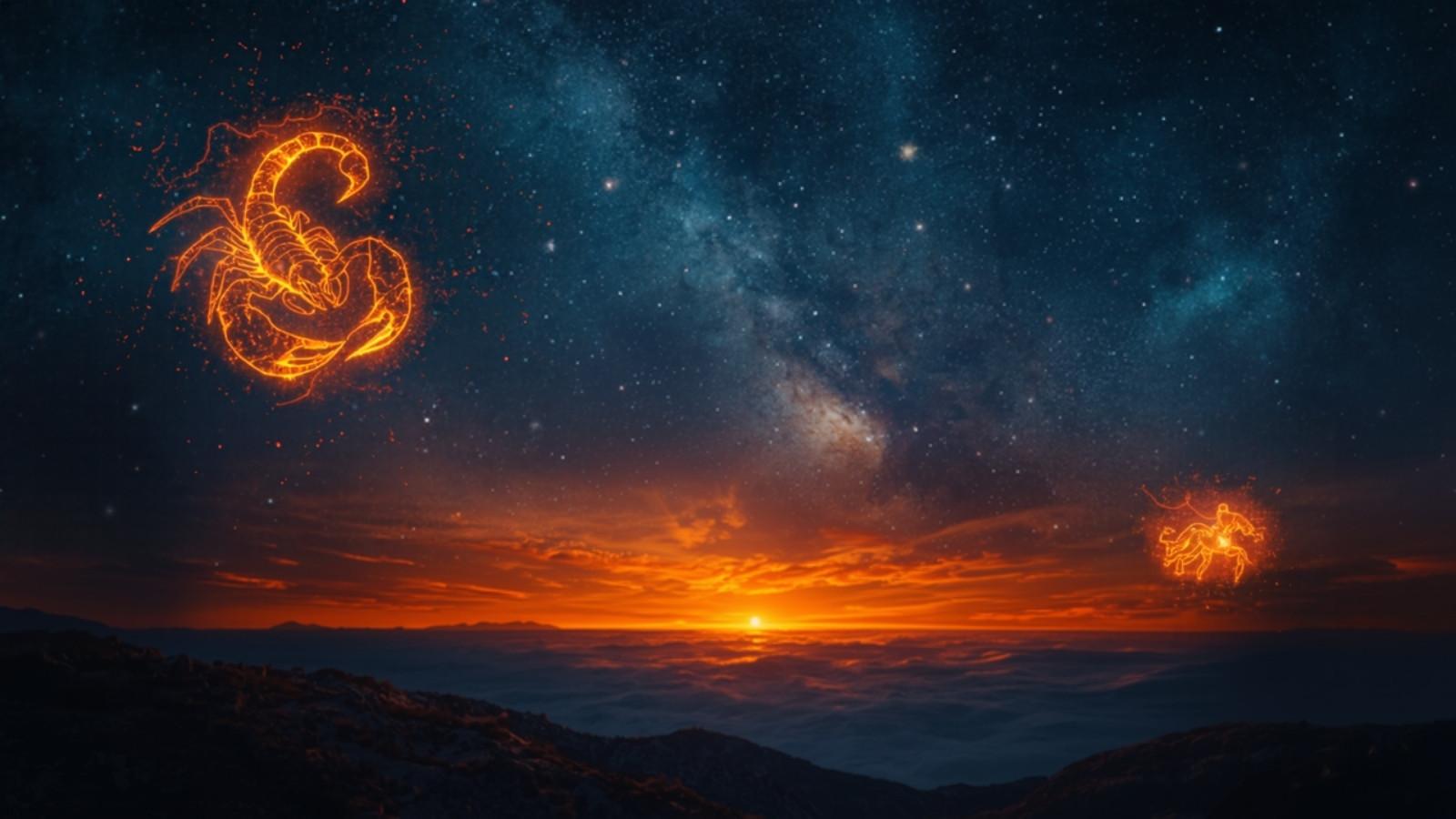

The Scorpio myth is one of the oldest stories still written across the night sky: a proud hunter named Orion, a scorpion sent to stop him, and two constellations placed so far apart that one always sinks in the west as the other climbs in the east. With the Sun moving through Scorpio until November 22, 2026, this is the season the story belongs to, and it explains a surprising amount about how astrologers describe the sign today.
The Scorpio Myth: Orion and the Scorpion
Orion was the giant hunter of Greek legend. Every version of his death ends with the same small creature, but the ancient sources disagree, sometimes sharply, about why the scorpion came for him.
The Greek poet Aratus, writing in the 3rd century BC in his star poem the Phaenomena, says Orion tried to lay violent hands on the goddess Artemis on the island of Chios. Artemis split open the hills and released a scorpion larger than the hunter himself, and its sting killed him.
The Roman mythographer Hyginus, in his Astronomica, gives a version built around pride. Orion boasted to Artemis (Diana) and her mother Leto (Latona) that there was no creature the Earth could produce that he could not kill. The Earth answered by sending a scorpion. Jupiter later set the scorpion among the stars, Hyginus says, so that people would remember what boasting costs.
Ovid, in Book 5 of the Fasti, softens Orion considerably. In his telling the hunter is walking with Leto and tells her no beast could defeat him. When the Earth sends the scorpion against the goddess, Orion steps in front of her and dies defending her, and Leto places him among the stars as a reward. The classical texts are collected in translation on the Theoi Project's page on the Skorpios, which is the easiest way to read the versions side by side.
Three writers, three motives: violence, arrogance, or loyalty. The constant is the scorpion, small, patient and impossible to outmuscle.
Why Orion and Scorpius Never Share the Sky
The most elegant detail of the story is astronomical, and it is real. Orion and Scorpius sit on nearly opposite sides of the sky. When Scorpius rises in the east, Orion is setting in the west, and the reverse is true six months later. Aratus already used this as the punchline of the myth: Orion still flees at the edge of the world whenever the scorpion appears.
That is why the two are seasonal opposites. Scorpius rules summer evenings in the Northern Hemisphere, with its curled tail low in the south. Orion is the great winter constellation. In mid-November, Scorpius has slipped into the glare of the Sun, while Orion climbs into the eastern sky during the evening and stands high by the early morning hours.
The Scorpio Constellation Story Before the Greeks
The scorpion is far older than Orion's legend. Babylonian astronomers listed a constellation called GIR.TAB, "the Scorpion," in the star catalogue known as MUL.APIN.
In the Epic of Gilgamesh, the hero reaches the twin peaks of Mount Mashu, where the Sun rises and sets, and finds the gate guarded by a scorpion-man and his mate. They let him pass into the long darkness beyond. Egypt had its own scorpion goddess, Serket, a protector who guarded against venom rather than wielding it. Long before the Greek stories, the scorpion already stood at thresholds: dangerous, but also a guardian of what lies on the other side.
How Scorpio Lost Its Claws to Libra
In early Greek astronomy, Scorpius was much bigger than it is today. The stars we now call Libra were the scorpion's claws, known in Greek as the Chelae. Roman astronomers later carved them off into a separate constellation, the Scales.
The old shape survives in the star names. Libra's two brightest stars are still called Zubenelgenubi and Zubeneschamali, from Arabic phrases meaning "the southern claw" and "the northern claw."
Antares, the Red Heart of the Scorpion
At the scorpion's heart burns Antares, a red supergiant star roughly 550 light-years away. Its name is usually read as "rival of Ares," the Greek god the Romans called Mars, because the star's reddish colour resembles the red planet.
The colour has shaped the sign's reputation. Astrologers traditionally gave Scorpio to Mars, and modern astrologers add Pluto as a co-ruler.
What the Scorpio Myth Means in Astrology
Astrologers read these stories as a portrait of the sign rather than a warning about it. The scorpion in every version is quiet, precise and unimpressed by bravado. It does not compete with Orion on his terms; it waits for the right moment. That is close to how Scorpio is usually described: perceptive, private, loyal once trust is earned, and allergic to empty boasting.
The guardian theme matters just as much. Gilgamesh's scorpion-people and Ovid's version of Orion both stand between someone and danger, and many astrologers describe Scorpio's intensity as fundamentally protective. If you are a Scorpio, the myth suggests your strength works best when it is patient and aimed at something you care about. You can follow how this season is playing out for you on the Scorpio daily horoscope, and read the full sign profile on our Scorpio zodiac page.
This Scorpio season has had its own story, too: Mercury spent most of it retrograde in Scorpio and turns direct on November 13, a shift covered in our piece on Mercury retrograde ending in November 2026.
Seeing the Scorpio Story in the November Sky
The astrological sign and the constellation are not the same thing, which surprises many readers. The sign of Scorpio covers the 30 degrees of the zodiac that the Sun crosses from late October until November 22, 2026, when it enters Sagittarius around 07:20 UTC. The constellation Scorpius is a group of stars, and because of the slow wobble of Earth's axis, the Sun passes in front of it later in the year, only for about a week around November 23 to 29, before moving on to Ophiuchus, according to EarthSky's guide to the Sun's path through the zodiac constellations.
So this month you will not see the scorpion; it is hidden behind the Sun's light. But you can see its old rival. Step outside a few hours after dark and look east for the three stars of Orion's Belt. The hunter is up, and by the old story's logic, he is safe for now. For more on what is moving overhead, see our planets guide.
Frequently Asked Questions
What is the Scorpio myth in Greek mythology?
It is the story of the hunter Orion, killed by a scorpion sent by Artemis or by the Earth itself, depending on the source. Both were placed in the sky, on opposite sides, so that Orion sets whenever Scorpius rises.
Who sent the scorpion to kill Orion?
Aratus credits Artemis, after Orion attacked her. Hyginus and Ovid say the Earth sent it, either to punish Orion's boasting or, in Ovid's version, to threaten Leto, whom Orion died defending.
Why can't you see Orion and Scorpius at the same time?
They lie on roughly opposite sides of the sky, so one is rising while the other is setting. In practice Scorpius is a summer evening constellation and Orion a winter one in the Northern Hemisphere.
Is the constellation Scorpius the same as the sign Scorpio?
No. The sign is a fixed 30-degree section of the zodiac the Sun crosses from late October to about November 22. The Sun is in front of the constellation's stars for only about a week in late November.
The scorpion has been guarding gates and humbling giants for some three thousand years without ever raising its voice. As Scorpio season closes on November 22, it is a fitting story to carry with you.