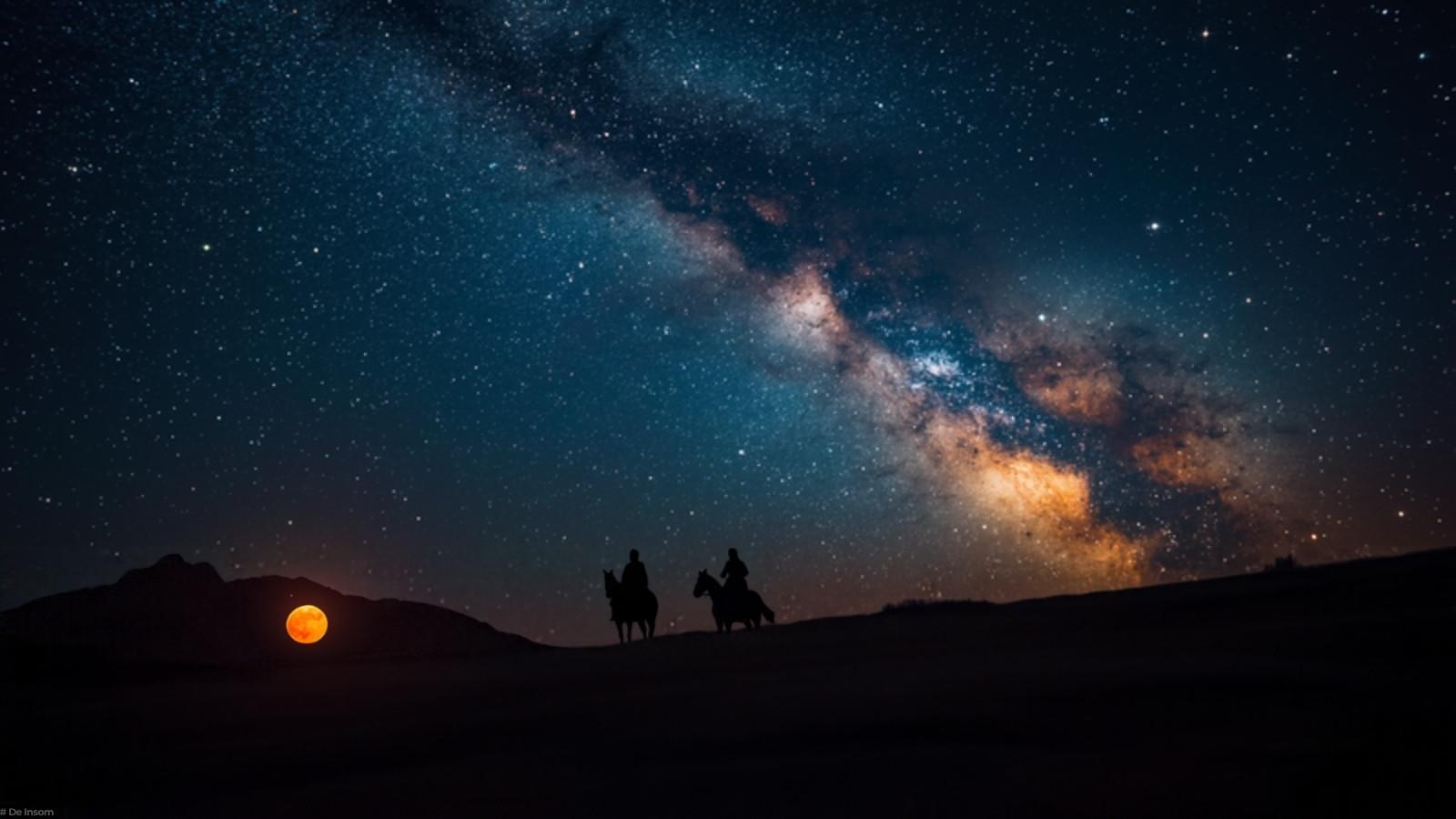

The Castor and Pollux myth is the story behind Gemini, the Twins, and late November is a fine time to tell it. The full Moon of November 24, 2026 (14:53 UTC) falls at 2° Gemini in the zodiac, and over the following nights the Moon climbs toward the two bright stars that carry the brothers' names, passing about four degrees from Pollux on the night of November 27–28. Three weeks later the Geminid meteors stream out of the same corner of the sky. Here is who the twins were, why only one of them was born immortal, and how their bargain with Zeus still shapes the way astrologers read Gemini.
Castor and Pollux Myth: The Twins Born of Leda
In Greek myth the twins were called the Dioskouroi, "sons of Zeus," and Pollux is the Latin form of the Greek Polydeukes. Their mother was Leda, queen of Sparta. On the same night she lay with her husband, King Tyndareus, and with Zeus, who had come to her in the form of a swan. The result, as later writers told it, was two sets of children with two different fathers. Castor and his sister Clytemnestra were mortal children of Tyndareus; Pollux and Helen, later "of Troy," were children of Zeus. Several versions say the children hatched from an egg.
That split inheritance is the heart of the story. The brothers were raised as equals, inseparable in everything, yet one of them would die and one could not. Britannica's entry on the Dioscuri sets out the parentage and the main variants of the legend.
Why Is Gemini the Twins? The Brothers' Adventures
Before the tragedy came a long run of heroic exploits, and each one shows a different side of the pair.
Helen's rescue
When the Athenian hero Theseus carried off the young Helen, her brothers marched into Attica, brought her home to Sparta and took Theseus's mother Aethra back with them as a captive.
Sailing with the Argonauts
Both brothers joined Jason's crew on the Argo. Pollux, famed as a boxer, defeated Amycus, the brutal king of the Bebryces, who challenged every stranger to a fight. Castor was remembered above all as a tamer of horses. Sailors came to see the twins as their protectors, and the glowing electrical discharge that sometimes crowns a ship's mast in a storm, later called St. Elmo's fire, was read as a sign that the Dioskouroi were aboard.
The Death of Castor and Zeus's Bargain
The ending is told in several versions, but the core is consistent. The twins quarrelled with another pair of brothers, their cousins Idas and Lynceus, first over a cattle raid in which Idas cheated them of their share, and then over Phoebe and Hilaeira, the daughters of Leucippus, whom the Dioskouroi carried off although they were promised to the cousins. In the fight that followed, Idas killed Castor with a spear. Pollux killed Lynceus, and Zeus struck down Idas with a thunderbolt.
Offered a seat on Olympus for himself alone, Pollux asked instead to share his immortality with his brother.
Zeus agreed. From then on the twins lived turn and turn about, one day among the gods and one day in the underworld, always together. Homer's Odyssey already knows this arrangement, describing the brothers as alive on alternate days by the gift of Zeus. In the most popular later telling, Zeus also set them in the sky as the constellation Gemini, side by side for good. The Wikipedia article on Castor and Pollux collects the ancient sources for each version.
From Sparta to Rome
The twins were worshipped far beyond Sparta. Roman tradition held that they appeared on horseback at the Battle of Lake Regillus in the early fifth century BC, and three columns of the Temple of Castor and Pollux, rebuilt many times since, still stand in the Roman Forum.
Castor and Pollux Stars: The Twins in the Night Sky
Our illustration shows the Castor and Pollux myth as a pair of starlit twins on horseback against the winter Milky Way.
The myth has a neat echo in astronomy. The two bright stars that mark the twins' heads look like a matched pair, yet they are very different objects.
- Pollux (Beta Geminorum) is the brighter twin, magnitude about +1.2, an orange giant roughly 34 light-years away. A planet at least twice the mass of Jupiter, named Thestias, orbits it, according to EarthSky.
- Castor (Alpha Geminorum) is slightly dimmer at about +1.6 and lies around 51 light-years away. Through a telescope it splits into a pair, and the whole system holds six stars, as BBC Sky at Night Magazine explains.
- Where to look: in late November Gemini rises in the east-northeast by mid-evening and is high in the south before dawn, to the upper left of Orion for northern-hemisphere viewers.
- Geminid meteor shower 2026: the peak falls on the night of December 13–14, with up to about 75–150 meteors per hour under dark skies and only a thin crescent Moon that sets in the evening, according to Farmers' Almanac. The meteors appear to radiate from near Castor, and their parent body is the asteroid 3200 Phaethon.
Like the brothers of the myth, the two stars look alike from a distance and reveal their differences up close.
Gemini Mythology in Astrology: What the Twins Mean for the Sign
Astrologers read the Castor and Pollux myth as the key to Gemini's character. The sign, which the Sun occupies from about May 21 to June 20, is linked with conversation, siblings, short trips, curiosity and the ability to hold two ideas at once. The twins supply each theme: the bond between brothers, constant movement between two worlds, and fierce loyalty.
Seen this way, Gemini's famous "duality" is less about being two-faced and more about being two-sided. The sign is often described as bridging the practical and the inspired. Gemini is ruled by Mercury, the messenger who also crossed between Olympus and the underworld, so the theme of travel between worlds appears twice over.
What the November 24 full Moon in Gemini highlights
Astrologers read a full Moon in Gemini, opposite the Sun in early Sagittarius, as a time when facts and beliefs meet. It suits clearing up a misunderstanding with a sibling or close friend, or finishing a piece of writing. You can follow how this plays out for your sign in the Gemini daily horoscope and in our guide to Sagittarius season 2026, which starts on November 22.
Frequently Asked Questions
Who are Castor and Pollux in Greek mythology?
They are twin brothers, sons of Leda, also called the Dioskouroi. Castor was the mortal son of King Tyndareus of Sparta and Pollux the immortal son of Zeus; together they rescued their sister Helen and sailed with the Argonauts.
Which twin was immortal, Castor or Pollux?
Pollux was immortal because his father was Zeus. When Castor was killed, Pollux chose to share his immortality so that the brothers could spend alternate days on Olympus and in the underworld together.
Why is Gemini represented by twins?
The constellation Gemini was identified with Castor and Pollux, whom Zeus placed side by side among the stars after their bargain. Its two brightest stars still carry their names.
Is Pollux or Castor the brightest star in Gemini?
Pollux is brighter, at about magnitude 1.2, even though Castor is labelled Alpha. Pollux lies about 34 light-years away, Castor about 51.
When is the Geminid meteor shower in 2026?
The Geminids peak on the night of December 13–14, 2026, and are active from December 4 to 20. A thin crescent Moon sets early, leaving dark skies for most of the night.
The Castor and Pollux myth endures because it is simple and generous: one brother gives up half of forever so the other is never alone. Look up at the twin stars after the November 24 full Moon, or during the Geminids in December, and you are looking at that promise. For more sky stories, read our Pleiades mythology feature and the astrology calendar for November and December 2026.